Tuesday, June 18, 2013

2 books by Pema Chodron

The Wisdom of No Escape and the Path of Loving Kindness
When Things Fall Apart: Heart Advice for Difficult Times
Pema Chodron
USA

            Last night I came home from work and I didn’t feel good. I was tired and my eyes were glazed; I felt brain-dead and a little sad. Anxiety about time and losing it, and a familiar associated feeling of guilt and fear started up their regular rotation in my brain. I recognized that I was on the edge from which I have so often fallen into a pit of depression. This time, though, was different. This time I remembered what I’ve been reading in Pema Chödrön’s books about gentleness, curiosity, and non-judgment, and I decided not to feel bad about feeling bad (I didn’t even try to stop feeling bad, just to stop feeling bad about feeling bad). I remembered that instead of being angry I could make friends with myself and notice with a friendly curiosity how I was feeling and maybe why, but I didn’t have to condemn myself for it; I didn’t have to fall into the trap of thinking there was something wrong with me just because I didn’t feel great. As soon as I remembered this and relaxed into my feelings, allowing them to be what they were, they changed. The negativity seemed to break apart, dissipate, and pop like carbonated bubbles in the air. I felt lighter, better. Such is the power, when we’re strong enough to use it, of a Buddhist approach to life’s everyday trials.  
            This is why I study Buddhism, at least in part. The other, even better part is that the benefit is not only personal. In this case, because I felt better I didn’t pick a fight with my husband when he came home. Because I was relaxed, I was able to go out and be kind to my friends and to strangers. Because I was at peace I could smile and pass that peace on to others, instead of infecting them with depression. Buddhism teaches this mutual benefit, and Chödrön reminds us of it in The Wisdom of No Escape: “… we are actually needed. Individuals who are willing to wake up and make friends with themselves are going to be very beneficial, because they can work with others, they can hear what people are saying to them, and they can come from the heart and be of use.” This is the other reason I study Buddhism - because, selfishly, I want to help the world.
I say that wanting to help the world is selfish because the state of the world often causes me a great deal of fear and anxiety and guilt. So, selfishly, I want to change things so that I can get rid of these unpleasant emotions in myself. But what I’ve learned from Buddhism is that actions driven by fear and anxiety and guilt cannot generate peace and happiness and love - they will only perpetuate more fear and anxiety and guilt. I (we) need a way to find peace and gentleness inside of ourselves before we can expect to produce those qualities in the wider world. I’ve read a lot of Thich Nhat Hanh in the last six years, and he has taught me this. Like many westerners, TNH has been my introduction to Buddhism and, through his books, my spiritual teacher. I love him and am so grateful for his work, which has quite literally changed my life. At the same time, though, I decided it might be a good idea to diversify my spiritual diet, to diverge from my comfortable habit, so to speak. My sister, who has been studying Buddhism too, lent me these two books by Pema Chödrön, and I have benefited greatly from them both. I don’t think you have to have studied Buddhism previously to benefit, though a little bit of background could definitely help.
            Neither of these books gives a general overview of Buddhism or its teachings, and neither is focused around a single topic, as Hanh’s sometimes are. Instead, both books are comprised of the transcripts of short talks by Chödrön: Things Fall Apart from various talks between 1987-1994, and No Escape from a one-month meditation retreat in Nova Scotia in 1989. As such, Things Fall Apart is somewhat less cohesive and harder to follow than No Escape.            Despite When Things Fall Apart’s lack of obvious progression, it is a very worthwhile read. If you’re new to Buddhism, you might read it slowly, over the course of a few weeks or a month. If you read a chapter or two at a time, and then stop to let them sink in, it doesn’t matter as much that each chapter is completely new, and in a “plot” sense (though definitely not a spiritual one) unrelated to the last. Perhaps it’s even appropriate that the book is a bit jumbled, a bit here and there; life is like that, too. We encounter this and that and the other thing all the time, all at once, and presenting each point separately might in fact give us an unduly simplistic view of the teachings. A lot of the stuff discussed in this book was familiar to me already, but one topic was completely new, and extremely enlightening and useful. That is the practice of “tonglen.”
Tonglen is a Tibetan Buddhist meditation technique that means “sending and receiving.” “It is a practice of taking in pain and sending out pleasure and therefore completely turns around our well-established habit of doing just the opposite.” Chödrön, who was a student of Chögyam Trungpa Rinpoche, the founder of Shambhala meditation centers, and Naropa University, talks over and over again in both of these books about our tendency to seek pleasure and avoid pain. This habit, she suggests, actually contributes to our pain. In running away and attempting to wriggle free from pain we defeat the purpose of the pain, which is to understand it. Tonglen is a method for staying with and addressing the pain we see around us. “When we see a woman and her child begging on the street, when we see a man mercilessly beating his terrified dog, when we see a teenager who has been badly beaten or see fear in the eyes of a child, do we turn away because we can’t bear it? Most of us probably do. Someone needs to encourage us not to brush aside what we feel, not to be ashamed of the love and grief it arouses in us, not to be afraid of pain.” Instead of getting away from these unpleasant feelings, Chödrön advises us to do the exact opposite – to actually open further to the unpleasantness. “Whenever we encounter suffering in any form, the tonglen instruction is to breathe it in with the wish that everyone could be free of pain. Whenever we encounter happiness in any form, the instruction is to breathe it out, send it out, with the wish that everyone could feel joy. It’s a practice that allows people to feel less burdened and less cramped, a practice that shows us how to love without conditions.” This idea struck me right away as revolutionary, and very practical. Off and on, (definitely with less than ideal discipline) I’ve been trying to cultivate it as I move about the suffering-filled streets of NYC. It’s not at all easy; it requires opening rather than closing. But what I like about it is that it offers a solution: instead of being bitter and angry about injustice, which only makes things worse, we can be gentle and loving towards those who suffer, which might just help us all.

            The Wisdom of No Escape, the second Chödrön book I read, was shorter and a little bit easier to read. It hangs together better because she’s talking to the same group of people over the course of one month. In both books I really like Chödrön’s voice. She is humble, gentle, and not overly cute. She often tells seemingly banal stories about how she failed to uphold her own ideals and how she (and we) can learn from that. For example, if you intended to only eat one cookie, and then you ate three (as I did the other day), you can respond in a variety of ways. You could get angry at yourself, or depressed, or say “Screw it; I’m going to eat badly for the rest of the day, because now it doesn’t matter,” or any number of less-than-useful reactions. Or, you could respond with a gentle curiosity about why you overate. Obviously it wasn’t about being hungry; perhaps you were upset about something or feeling scared, or tired, or put upon in some way. You can notice and not judge, instead of spiraling into a pit of despair. These are the kinds of stories Chödrön tells because these are the kinds of “problems” we so often have. Ridiculous problems! And yet if we don’t address them in a positive way, they can become very big, very real problems. If we don’t figure out why we made the choice we did, we will just carry on with our habits that lull us into sleep when we need to be awake. And if we can’t react well to a small problem, we’re certainly not going to do any better when shit really hits the fan.

It’s very important that we are awake to our own thinking because “by the way that we think and by the way that we believe in things, in that way is our world created.” Chödrön is not saying that she has it all figured out, or that Buddhism will tell us what is true and what is false. Actually, what she’s saying is that it’s problematic to believe anything to the point that you no longer question it. She refers to a Buddhist teaching that says, “‘If you meet the Buddha on the road, kill the Buddha.’ This means that if you can find Buddha and say, ‘It’s this way; Buddha is like this,’ then you had better kill that ‘Buddha’ that you found, that you can say is like this. … when you see that you’re grasping or clinging to anything, whether conventionally it’s called good or bad, make friends with that. Look into it. Get to know it completely and utterly. In that way it will let go of itself.” This kind of advice – to “look into it” – is very Chödrön. It’s very Buddhist. It’s also very hard, and often, as the title of one of her final chapters reflects, quite “inconvenient.” It’s a lot easier to let someone else tell you what is true and what isn’t, but figuring that out for yourself is the only way to see clearly what is. Chödrön’s books are extremely helpful tools in that endeavor. 

Saturday, March 9, 2013

Travel Reading

Hello! It's a sunny day here in New York City, but it hasn't been that way much lately. It's that time of year when we all get really tired of winter, and start daydreaming about the easy days of summer: flowy dresses, flip flops, rum cocktails, walking in hot sand... Like many of you, no doubt, I don't plan to wait for June to enjoy such luxuries. To get our fix quicker, my husband and I are going to Negril, Jamaica at the end of March. I've never been to Jamaica, and I can't wait to go swimming (look at that water!!) and soak up some sun.

As I've been told that Jamaica, while incredibly beautiful, is perhaps not the safest place on Earth, I don't plan to bring any electronics to entertain me. (I hate the way they heat up in the sun, anyway). So, it will be old fashioned books all the way. (I'm making silly excuses; it's pretty much always old-fashioned books for me.) So, I need to know what to read! When I travel, I like to read things about the country I'm in, or that seem related to the environment in some way. I'd love to hear suggestions for the right thing to read in Jamaica. I've recently watched the documentary, Life and Debt, about how the IMF and the Worldbank have, to put it delicately, screwed Jamaica over, so I have a teensy bit of knowledge about the country's history, but I'd love to know more. Also, as I tend to gravitate to the heavy, philosophical stuff, additional recommendations for light-hearted beach reads would also be appreciated.

I hope you have a spring fling planned yourself! Let me know if you need book recommendations!


Friday, January 11, 2013

A Great Month for Books


It has been a great month for books so far in the Morgan household! Since school has been out I’ve been collecting books like they’re going out of style, which of course you and I both know will never be the case. Here’s a run-down of some of my recent good biblio-juju.

Alabaster Books, NYC          
The first great book day was a couple of weeks ago when I went to meet a friend for coffee in Manhattan. While we sat sipping our small black brews in the window of Think Coffee on 4th Ave near Union Square I noticed a small, unassuming book shop across the street with an unusual name: Alabaster Books. Not that either of us “needed” any new books, but we both love them and were in no hurry so decided to do some browsing. Alabaster is a small, jumbled place that felt quaint and inviting on a Sunday morning before the hordes had ventured out. We spent a long time in there and both walked away with some very nicely priced items. I got Jane Eyre by Charlotte Bronte, which I've never read before, and Three Guineas by Virginia Woolf, which I've read a lot about but also never read. We headed to The Strand after that and had a wonderful hour browsing in there, but I resisted buying more because the prices weren't as good as Alabaster and I remembered that my dearest step-dad had sent me a gift card to Amazon.com for my recent birthday…

Amazon.com  
Of course, I used my gift card to buy books. I got: Virginia Woolf, by Hermione Lee (just finished reading it from the library but decided I needed to own it, too), Virginia Woolf: A Biography, by Quentin Bell (to compare), Jacob’s Room, by Virginia Woolf, Moments of Being, by Virginia Woolf, The Electric Koolaid Acid Test, by Tom Wolfe, and Fun Home, by Alison Bechdel. It’s amazing what you can get for $50 on Amazon! So cheap, but much more fun to go browsing at The Strand and little shops like Alabaster. Anyway, so far I’ve received all of my purchases except for Fun Home, but haven’t started reading any yet because right now I’m on Hell’s Angels: The Strange and Terrible Saga of the Outlaw Motorcycle Gang by Hunter S. Thompson, which I borrowed from a friend. Also, in case you’re wondering, yes, I have a Woolf (and also Wolfe) project in the works.

Propeller Books, Portland, OR
I love getting books in the mail! I love it even more when they’re beautiful, as the titles from Propeller Books always are. Because I’ve been writing a recurring column (titled Mostly Novels, wouldn’t you know) for their online magazine, www.propellermag.com, the good folks at Propeller saw fit to send me a couple of their books that I haven’t yet had the pleasure of reading. The story collections, Nine Simple Patterns for Complicated Women, by Mary Rechner, and Disorder, by Dan Deweese, arrived in my mailbox a few days ago, and I can’t wait to get started on them. Everyone says this about Propeller Books but I’ll just go ahead and repeat because it’s so true: they are beautiful objects. The covers are soft and supple, the papers are crisp and smooth, and the designs are uncluttered and soothing to the eye – all of this combines so that the experience of reading is elevated beyond the intellectual to the sensual. It all makes you want to arrange the rest of the reading experience to match – smoking robes and low light and just the right cup of tea. I know this because I did read another book published by Propeller, A Simple Machine, Like the Lever, by Evan P. Schneider, which is beautifully sparse and sad, and about which I have been meaning to write a post for far too long now.

The Dude
As I told you in my last post, one of my New Year’s resolutions is to make better use of New York City. As such, I’ve joined a email list that provides information about free and cheap things to do around town. This email let me know (as did New York magazine before it, my subscription to which is part of the same plan) that The Dude from The Big Lebowski, aka Jeff Bridges, and Zen Master Bernie Glassman have written a book together called The Dude and The Zen Master, which they would be discussing in person at Barnes and Noble Union Square on Tuesday night. So off I went. I had to buy the book to get a seat (this was not the case when I saw Candace Bushnell there seven years ago), but it was worth it to see and listen to Jeff Bridges up close and personal. The talk was a little haphazard, but so far the book is nice. Not too heavy, man, but still deep, you know?

So now I need to buy more bookshelves, and/or find a bigger apartment.       

Tuesday, January 1, 2013

New Years Reflections: Doing What's Best for Me


 Happy New Year, novel readers! As is customary, I am spending today reflecting on the past year. 2012 was a big one for me: I got married, moved back to NYC, and turned 30. In addition to all that, I think I’m finally moving in a positive direction in my career. Writing, editing, and teaching jobs keep coming my way, piling up slowly but steadily. I feel more focused and engaged in my work than I have in a long, long time, and I couldn’t be happier about it. This is a result of other changes, of course – there’s a lot less partying in my life these days, a lot more cooking and running and writing and sleeping, but that’s as it should be as one grows older, or so I’m told. Which brings me to what I want to talk about today: how things, or rather how we, “should” be, and what that means to me lately. In the past few months, with the holidays and the end of the semester swarming all around me, I’ve come to realize a few things about “should” that I thought I would share with you.

First of all, Christmas. You should be with your family at Christmas, right? Well, I’m from Iowa, my husband is from Oregon, and we have family all over. We both love our family and treasure the time we get to spend together, but with the prices for plane tickets at Christmas astronomical, and the expectation of gifts nearly as high (expected by “society,” that is, not by our family necessarily) Brian and I decided that we were just not going to do it this year. We’ve had a big year, and, truth be told, New York and our jobs have been wearing us out. We needed sky and air and trees and rest, not events and presents and all day eating fests. So we went skiing in Vermont for five days, just the two of us, and it was perfect. It was exactly what we needed, and when we came back to New York we were rested and rejuvenated, not fat and exhausted. This is not to say that next year we won’t want to go home, or plan a joint trip with our family. It’s also not to say that if you went home and sat around eating for five days that you did it “wrong.”  It’s just that we knew that right now, this year, flying far away didn’t work for us, and so we didn’t let anyone else’s idea of what we “should” be doing deter us from what we really wanted to do.

I should clarify something – the “should” in this equation is, in a sense, not real. No one actually said that we should do anything in particular at Christmas. No one literally told us to travel anywhere or buy anything. Our family were 100% supportive of our plans. The “should” I’m referring to is, mostly, in my head. It’s some little voice inside me that tells me what other people are going to say, either to or about me. Yes, there are the advertisements; those are real. There are the Christmas songs, and those are real too. But I knew (or at least I expected) that our families would be fine with our Christmas plans; it was only my inner critic that was hounding me, a critic based on my real or perceived understanding of American traditions that I seem to have been cultivating all of my life, to my own detriment. Let me give you another example.

What are you supposed to do on New Year’s Eve? You know the answer – wear a sparkly hat, blow a noisemaker, and get drunk, right? But what if you don’t want to? What if you live in New York City and you just want to go out and get dinner with your husband in your quiet Brooklyn neighborhood? Is that okay? According to my inner critic, and plenty of real people I have heard over the years, it is definitely not okay, not if you want to be cool. On the other hand, according to the new, older and wiser me, who’s learning to ignore that bitch, it’s totally okay! And so that’s what we did. We hung out with some neighborhood friends and chatted and drank very little and had a relaxing, if not terrifically exciting, New Years Eve. Maybe next year I’ll feel like getting drunk. Or maybe I’ll feel like staying in and going to bed at 10 o’clock. Either way it will be okay, as long as I’m doing the best thing for me on that day, and not living my life based on other people’s ideas of how it should be done.  

Figuring out what works best for me does not mean that I have to go against convention; it also means that I don’t have to follow it. It does not mean doing the hardest thing, and it does not mean doing the easiest thing. It definitely does not mean being selfish – I’m not saying I’m doing what’s best for me at the expense of everybody else. I’m doing what’s best for me so that I can better love and cherish and appreciate and inspire everybody else. Taking care of ourselves is good for each other. You taking care of yourself is good for me.

Obviously, the hard part is figuring out what’s best for me. It doesn’t come in a daily email; there’s no app. It’s hard for the same reason that writing is hard – because it changes every single day, every single moment, because you have to constantly accept new data and reevaluate. But that’s where reading comes in handy. I know that a big part of the reason I’m coming to these realizations at all is because of what I’ve read, both fiction and not, and because I’ve been reading extensively (some might say excessively) since I can remember being alive. Books have taught me that there is no standard response to life’s complexity. From reading novels I have learned that people do things differently, feel things differently, have different religions, and different priorities. But underlying all of these differences are general truths – kindness and generosity are universally acknowledged as positive forces. Forgiveness of self and others seems less obviously a shared value in our everyday culture, but in novels it is. I have traveled near and far, but most of what I know comes from reading novels. One thing I know is that judgment, both of self and of others, is a negative force that helps no one. This is something that I’m going to try to do a better job of remembering in 2013. May I read books that remind me of it, in a million different ways.

A few other things I want to do in 2013 are:
See more live music
Do more yoga
Make better use of all NYC has to offer
Write more posts for Mostly Novels!


Thank you so much for reading my blog. May you know what is best for you this year, and have the strength and faith to act on that knowledge.

Happy New Year, everyone!


Tuesday, November 27, 2012

Cloud Atlas, Mitchell


Cloud Atlas
David Mitchell
2004
Britain          


Plenty of authors are willing to tell us how bad things are. Literary fiction readers lack not for doom and gloom. Even that former harbinger of a comedic, post-racial society to come, Zadie Smith, seems to want to tear down hope in her latest tome, NW. Maybe I should be okay with that. And maybe I’m just getting old, but I admit – I want literature to offer a silver lining of hope even at the bottom of a dark truth cloud. Like I tell my students – it’s easy to point out what’s wrong; it’s a lot harder to figure out where we go from here. Cloud Atlas, a beautiful, dense, “Russian nesting doll” of a book, manages to do both.

Cloud Atlas is about reincarnation. (If you’re not sure just watch the movie; it is impossible to miss). The lives of the six characters it follows don’t overlap so much as brush up against one another. Luisa Rey swears she’s heard the Cloud Atlas Sextet by Robert Frobisher somewhere before. Robert Frobisher reads Adam Ewing’s diary. Zackary of Baily’s Dwelling worships Sonmi as a god. Sonmi is influenced by a film made by Timothy Cavendish. Timothy Cavendish reads mystery novels written by Luisa Rey. And so on. The book begins in 1845 and moves chronologically through time to the two futuristic narratives – Sonmi, a “fabricant” in a “corpocratic” society in 2144, and Zackary, a goat herder in Hawaii in a distant future after “the fall.” After this outward movement, the book moves in again, like clouds wafting in a never-ending progression across the sky. The cyclical rotation is highly thematic. David Mitchell wants us to know that he’s talking about recurrence, repetition, eternity, the way the Earth rotates, and our continuous cycles around the wheel of the Earth, from birth to death to birth again. Though he mentions Christian, secular, and scientific ideas, as well as Buddhist ones, Mitchell suggests that Buddhism is the most useful because it acknowledges reincarnation and interbeing (that we are reborn as different people in different lifetimes, and that we are connected to everyone else in unexpected and unseen ways). Despite several mentions of Buddhism and strong thematic connections, Mitchell isn’t merely proselytizing; the book is entertaining and unique enough at the level of story that it avoids being polemical (many have written that the movie does not succeed in this regard; I would agree, but think that it’s fun to watch anyway. Then again, I agree strongly with its claims).

On the one hand, the message of the text is obvious – déjà vu comes up in every section and, in case you didn’t get it, each character has a comet shaped birthmark, suggesting that they might be one of the others reborn. This is all familiar to me from my study of Buddhism.  But something Robert Frobisher, the character from the 1931, says complicates my understanding of Mitchell’s concepts of reincarnation and time. The composer, Frobisher says, “Rome’ll decline and fall again, Cortes’ll lay Tenochtitlan to waste again, and after, Ewing will sail again, Adrian’ll be blown to pieces again, you and I’ll sleep under Corsican stars again, I’ll come to Bruges again, fall in and out of love with Eva again, you’ll read this letter again, the sun’ll grow cold again. Nietzsche’s gramophone record. When it ends, the Old One plays it again, for an eternity of eternities.” According to Frobisher, not only will we be reborn to another life on Earth, but maybe into the very same one. The structure of the book also indicates that we are doomed, if not to literally return to the same time, place, and body, then at least to repeat the same patterns “for an eternity of eternities.” Is there no Nirvana, no extinction, no respite from the cycle to look forward to?

Cloud Atlas is not only about reincarnation but also about the nature of that recurrence. The book suggests that though we progress, we also fall back. The struggle between the forces of good and evil is ongoing. While Mitchell doesn’t offer a lot of hope that evil will ever be permanently abolished, he does hint that good could be. So, while it seems we are unable to permanently “fix” the world, in fact it takes our very best efforts just to maintain the status quo. As these things tend to go, the movie is more uplifting than the book, showing a vision of interconnection that dwells more on the heroic acts of extraordinary individuals than the negative doings of the masses. Still, Mitchell leaves us with a tentative hope. At the very end the 19th century notary, Adam Ewing, expresses disgust with the world, and the desire to create a better one for his son. To do this, he proclaims, he will work for the Abolitionist cause. He imagines that his father-in-law’s response to this will be that it’s an admirable but impractical goal; people will never change; Adam’s actions will be nothing more than a drop in the ocean. To this hypothetical critique Adam replies, “Yet what is any ocean but a multitude of drops?” Adam wants to end slavery and, indeed, chattel slavery was abolished. On the other hand, the book questions the “once and for all-ness” of an idea like the “end” of slavery, since, in the future sections, slavery returns, albeit in a different guise.  The indication might be that the equally strong forces of good and evil are at work at all times. Sometimes the good is heavier, and sometimes the bad. What we do, Mitchell suggests, does alter the course of history, even if it doesn’t do so permanently. We may not be able to change the nature of people in general, but if we change the way we are, we will affect the quality of our own and others’ worlds right now. Stasis may be the only progress available, but it’s not nothing.


Wednesday, November 14, 2012

NW, Zadie Smith


NW
Zadie Smith
England
2012


“Happiness is not an absolute value. It is a state of comparison.”


            Zadie Smith has always been good at writing about her particular time and place. What we loved about White Teeth, in addition to its comforting “warm-heartedness,” was its ability to capture the complex nature of life in the mix of London’s population at the end of the 20th century. On Beauty gave us the dense but endearing world of academic Massachusetts, and her newest novel, NW, brings us back to London, smack in the middle of right now. But whereas those other books ultimately delivered some kind of hopeful truth about life beyond their particularity, NW doesn't seem to do that or, if it does, it’s not enough of a prize for so much time spent with this lackluster cast of characters.
             NW begins with a section called “Visitation,” in which Leah Hanwell, a white woman of Irish descent, is visited by that common London feature, someone out to scam her for money. In this case the interaction with the young woman brings up feelings of empathy as well as lust for the protagonist; we learn that she is struggling with the fact that her husband wants to have a baby while she does not, though she hasn’t actually told him so.
This section is followed by “Guest,” in which we get to know Felix (unrelated to Leah though from the same NW London neighborhood) as he visits his dad, a guy about a car, and an ex-girlfriend. Leah’s section is moody, hazy, dream-like and often disjointed, while Felix’s is far more straightforward. Both Felix and Leah talk about a past fueled by drugs and sex, but Leah wants to hold on to that past, while Felix is grateful to finally be moving on. Juxtaposed with one another, it is hard to like Leah as much as the friendly, resilient Felix, who grew up in the projects with a Rasta father and a mostly absent, alcoholic mother.
After Felix’s short chapter comes the longest section of the book. In “Host,” we meet Keisha (later Natalie) Blake, a black girl, and Leah’s best friend, from NW London. Natalie’s section feels the most laborious to read, because it’s the longest but also because it’s the “flattest” in terms of character. We are told over and over again that Natalie does not have a personality, that she has no desire except to appear successful and well-adjusted to those around her. She is well aware of her posing, especially as she compares herself with Leah: “That’s you. That’s her. She is real. You are a forgery. Look closer. Look away. She is consistent. You are making it up as you go along. She must never know.” (Natalie’s beliefs about Leah differ slightly from my own. To me, Leah is “consistent” only in that she does not feel the need to make anything up at all, and therefore is drifting, rootless, while Natalie clings to reality, “albeit a contrived “reality.” Leah pushes all such grounding as far away as possible.) Natalie vaguely knows that she wants something real, but is conflicted about how to find it.
The novel suggests that Natalie is unaware of how much she has been shaped by the world outside herself, and that she fails to recognize anything inside as having value or meaning. “Natalie Blake and Francesco De Angelis [her husband] had opposite understandings of this word ‘choice.’ Both believed their own interpretation to be objectively considered and in no way the product of their contrasting upbringings.” It’s as if Smith wants Natalie to both actually be a stereotype, a stand-in for something larger than herself, and also a warning that modern life has a tendency to create such shells out of what might have been human beings. (“Something about Natalie inspired patronage, as if by helping her you helped an unseen multitude.”) Smith suggests that modernity is to blame for this predicament. In one example, Natalie hopes to find “the Real” through giving birth, but instead opts to medicate her pain away, such that she is barely even present at the births of her own children, and certainly not “conscious,” in the way Felix claims he is trying to be. “Pregnancy brought Natalie only more broken images from the great mass of cultural detritus she took in every day on a number of different devices, some handheld, some not.” Pregnancy, for Natalie, becomes yet another way to consume and internalize manufactured ideas of what life should be like.
Another example occurs when Natalie begins to seek sexual encounters via the internet. She actually goes to a few different houses in order to have sex with people she meets online. In one such encounter, she has hopes of having sex with two young men, but instead the men continue to jack off to “live” images on the internet, seemingly afraid of “the real thing right there in front of them.” All of this suggests that though Natalie, in our “post-racial” world, can now be the “host,” presiding at her own table, the leader of her own world, instead she slowly begins to realize that the world that has been sold to her is no more hers now than it ever was; it is only a story she has bought into, often quite literally.
The final section of the book is called, “Crossing,” and focuses mostly on Natalie’s long walk with Nathan, a man both she and Leah knew at school. All of the threads – Leah, Felix, Natalie, and Nathan – link in the end in an unexpected way. This union ultimately reinforces, rather than resists, the status quo, however. Leah and Natalie are no longer victims of the system, but enforcers of it.
Smith is excellent here, as she always is, at evoking the splendors and horrors of modern life – mentions of Amy Winehouse, a recurring gag about “the year people started saying --,” and Craig’s list ads all make an appearance. Reading the book on a malfunctioning e-reader on the packed, sweaty NYC subway, NW sometimes hit uncomfortably close to home for me. Such contemporary themes seem to emphasize the idea that some redeeming truth will soon be imparted. But if comfort is what I’m after, I’d better look elsewhere. Smith no longer seems willing to play the healer. Here she is, is quoted in a Guardian article from 2000:  "When I was little, we'd go on holiday to Devon, and there, if you're black and you go into a sweetshop, for instance, everyone turns and looks at you. So my instinct as a child was always to over-compensate by trying to behave three times as well as every other child in the shop, so they knew I wasn't going to take anything or hurt anyone. I think that instinct has spilled over into my writing in some ways, which is not something I like very much or want to continue." In NW, I think, we can see that child finally battling back against the need to be “three times as good.” I might not like what she’s doing, but I do admire the will and tenacity it must have taken her to do it.
I agree with what Lana Wachowski said in The Village Voice recently; creating art is inherently an optimistic act. And so I’m inclined to look for that shred of optimism in NW, even as it resists such a reading. Did I enjoy NW? Not really. Do I think what Smith is doing here is bold, inventive, and important? Yes. Her novel never implores but instead hints that we should resist standard readings; that we should fight against the corporatization and digitization of society; that we should create our own paths or, if nothing else, refuse to follow one at all. In light of such a message it makes sense that Smith refuses to tell us another pretty story from which we can walk away with a smile and a laugh. She wants something from us, and those of us who hear and respond to that call will be anxiously awaiting her next work, hoping that in it she will have further developed the ideas and insights she began here - in another important, and perhaps more enjoyable, book.


Tuesday, October 30, 2012

Cat's Cradle, Vonnegut

Hey everybody! Now that I'm writing for Propeller magazine I'm finding it difficult to get posts up here as well as there. So here is the latest, in which I discuss Kurt Vonnegut's Cat's Cradle in terms of today's disturbing environment of nuclear proliferation, and just how we're all supposed to deal with all that bullshit, man. To be found at Propeller via the following link:
http://www.propellermag.com/Fall2012/BurnsVonnegutFall12.html


Meanwhile, I've finished NW by Zadie Smith and have a review of that, too. Shall I post it up here? Would you like that? Say that you would...


Friday, October 19, 2012

Fiona Apple, NYC, October 16


Fiona Apple
NYC
Terminal 5
October 16, 2012

On Tuesday night I saw something truly amazing and inspiring. I saw a woman I unafraid to perform her personal, emotional, incredible art in all seriousness and earnestness, baring her passion and soul. She captivated every person in that room for so many reasons. The beauty of her voice, the depth of her lyrics, her talented band, her enchanting melodies, but over and above all of that we were attracted to her willingness to share her raw emotions with us. That's what we've always been attracted to in Fiona Apple and it's what keeps us coming back. There she is up there, that deep strong voice coming out of that tiny little body. This tiny woman with no man that we know of up there to vouch for her- no husband, no famous father to soften the knife of emotion she pierces herself and all of us with. And that's why she's so amazing. That's why her fans will fight her label for her, and keep coming back whenever she puts out a new album, no matter how long it takes in between. Because she's the real thing. She’s not hiding behind a facade of irony or cool; she’s not holding anyone’s hand. She’s real, raw, delicate, powerful. Everything I want to be in my own art. Everything I'm too scared to be. But I have no excuse, seeing her up there, writhing and shrieking and shaking and belting out these serious, real words that meant so much to all of us. I don't even have to perform; I can do my thing from the peace and anonymity of my own home and I'm still too scared to say the kinds of things she says, to own it the way she owns it. Fiona- I don't deserve you. 

Friday, October 5, 2012

New Column on propellermag.com

Hi Readers! I'm pleased to announce that I am now writing a bi-monthly column for Propeller Magazine's website. The first one went up today. Here's the link: http://www.propellermag.com/Fall2012/BurnsMarquezFall12.html

The column deals with my thoughts on One Hundred Years of Solitude by Gabriel Garcia Marquez - read immediately following my honeymoon in Marquez's native Colombia.

Enjoy!

Friday, September 28, 2012

Empire of the Senseless, Acker


Empire of the Senseless
Kathy Acker
1988
USA

I tried to read this book by Kathy Acker, Empire of the Senseless. I read to about pg. 75 out of 227 and I just can’t go on anymore. It’s fairly rare that I put down a book, but life is too short not to enjoy the hours you spend reading. Reading is supposed to be fun; even when it’s difficult there should be some element of enjoyment in it. I am not having any of that with this book. This book is FUCKING NUTS. It’s about a half-human/half-robot? And a pirate? I never would have guessed that, actually, but that’s what it says on the back. There are a lot of references to literary theory, lots of rape, and now some pretty intense apocalyptic, suicidal imagery… and I’m done reading. I get it – you’re experimenting and testing the boundaries, fucking with the status quo, the hegemony, the patriarchal norms and whatnot - maybe it just seems so dated and boring because it’s 2012, not 1988. 80’s Gertrude Stein… something better read in a theory course than on your couch alone. Oh, if only I had a theory course…

The reason I decided to try this book in the first place (which I already had because a friend who was downsizing gave it to me) was because another friend recommended it. Not directly, exactly, but we were talking about one of the classes I’m teaching now, called “The Art of Non-Fiction,” in part about the differences between fiction and non-fiction writing. And my friend said, “Oh, you would like Dodie Bellamy then.” And I said, “Who’s she?” And my friend said something about “New-Narrative,” a blending of fiction and non-fiction, and she said, “Kathy Acker is the same movement, kind of,” and I thought “I have that one at home,” and that is why I started reading. But I’m stopping. I’m stopping now. It’s much too much for one girl alone.

I’m pretty sure the friend who gave me this book, as well as the one who recommended it, must have read it for a class because surely, no one is reading this for fun. I would try it again, but I would need the help of a brilliant professor and, alas, I am not that professor myself. One of the many, many times I wish I was still a student in college, instead of the teacher…  

Tuesday, September 18, 2012

A run in Prospect Park


Today was the first day it hasn’t been sunny and crisp and beautiful. I went running in the park even though the clouds were wooshing grey and tumultuous across the sky and the wind was whipping the trees leaves into a furious wave-like rushing. I knew such weather would mean that the park would be empty, or close to it, and I was right. The long, sweeping meadows today contained only grass and hills. Since everywhere was shady there was no competition for the arcs of dark beneath the trees. The paths winding through the ravine and around the reservoir were wet and speckled with leaves clinging to the black asphalt, beautiful and clean and untrodden by the muddy feet of people and dogs and children. It was a lovely day, and though I ran hard and struggled now and then against the wind, my lungs sang for the comfort of breathing in fresh, wet air, and my eyes could have cried for the beauty of seeing only trees, grass, water, and the occasional fellow runner.  

A few weeks ago I made my first excursion to the Brooklyn Public Library, the big one, right at the entrance to the park at Grand Army Plaza. I went for a discussion group on Mrs. Dalloway but stayed for the books, picking up, among other things, Hermoine Lee’s biography of Virginia Woolf. The thing is too heavy to take about with me; it’s over 700 pages and is exhaustive, definitely for the scholar, not a popular audience. But I’m enjoying it. Not in the same way I enjoy the novels, of course, but it does at times have a similar quality of transporting one to an idyllic English past. You see, I’m a bit of an Anglophile. I have always loved reading Victorian and other early English literature, hell, even modern English literature, because it takes me over there, across the pond, and makes me feel like I, too, know something about the grey skies and the sloping heaths, the tea, the fish and chips, the fireplaces and cold English nights. I studied in London as a college student, and my romantic relationship with the Isle has never ended, though my romantic relationship with one of her subjects certainly did (and badly). But that hasn’t tainted my love of England. So, when I run in Prospect Park, in Brooklyn, on a dreary, wet day like today, I am partially running in Alexandria Park, and at Hampstead Heath, and in Hyde Park. I’m trudging through the muddy paths at Highgate Cemetery, and when I’m done I’m coming in out of the cold to a bathtub, and then a drawing room complete with drapes, and a fire, and a cup of tea.

And, when the air gets misty and lush, and refreshing droplets start to fall from an otherwise blessedly blue sky, I’m also back in Oregon. Running along that winding path of mine beside the calm, sturdy Willamette River, watching the birds flit and the squirrels scamper and the trees and grass blow in the breeze. It just feels so good to be out in air, to feel air on my skin, air untainted by garbage or urine or cigarette smoke or even pizza, perfume, or the fruity, welcome smell of marijuana. Just earth, damp and wet, dark and sweet, reminding me that while I am happy to be here, thrilled with the way life is going and excited about all the opportunities this city of cities has to offer, deep down, what I really want, is more time outside. This question keeps popping into my head as I run, as I feel the air on my skin, and it’s a good one, and I know the answer (miracle!) – what do you really want? I want a family, and a warm, cozy house to settle us all in. I want enough money to travel regularly. I want to keep on writing and teaching. And I want to be outside; I want to see more of the outdoors of this world, in all countries, in all places, and I want to meet the people who know the outdoors. I want to have these simple things, and I can. If I just come back to home – to the feeling of the air – and breathing, and reminding myself of the answer to that simple question every single day. 

Saturday, September 8, 2012

Going Home: Jesus and Buddha as Brothers, Hanh


Going Home: Jesus and Buddha as Brothers
Thich Nhat Hanh
USA
1999

“You love the apple; yes, you are authorized to love the apple, but no one prevents you from also loving the mango.”


I picked this book up because I am interested in the similarities between Jesus and Buddha, and because I find my faith and understanding expanded every time I read one of Hanh’s books. This topic, in particular, has meaning for me. When I was first learning about Buddhism the idea of letting go of my spiritual tradition, Christianity, was very hard for me. Of course, there were a lot of things about it that I didn’t feel comfortable with, hence my search for an alternative, but at the same time there were, and are, many aspects of the religion that I find meaningful, and that I was hesitant to give up, most of all the teachings of Jesus Christ. But Thich Naht Hanh says that we don’t have to abandon one tradition when we embrace another. In fact, he says, we shouldn’t.

First of all, Hanh, a Vietnamese monk who lives in a religious community in France, says that it is a mistake to focus on the teachings, on dharma or dogma, only, ignoring our lived experience. “What is the Dharma? The Dharma is not a set of laws and practices, or a stack of sutras, or videotapes, or cassettes. The Dharma is understanding, it is the practice of loving-kindness as expressed by life. You cannot see the Dharma unless you see a person practicing the Dharma […]”. According to Hanh, we get caught in ideas, concepts, and notions, and this is an obstacle to true understanding. This is as true, he says, in Buddhism as it is in Christianity. We have to let go of the idea that we already know everything. “Understanding is a process. It is a living thing. Never claim you have understood reality completely.” We have to allow learning to happen through experience, not just by reading and listening to monks and nuns, priests and pastors. Hanh seeks to guide Christians not by converting them to Buddhism, but by helping them to practice their own religion more deeply.

Hanh clearly wants to stay away from criticizing Christianity, yet the implicit critique is everywhere. There’s no doubt he thinks Buddhism offers more opportunity for inner peace and ease of suffering than Christianity does – at least in the way it is taught and practiced today. He seems to want to make the case that the same ideas could be found in both traditions, if one just looks at them a little differently. For example, “Practicing Buddhist meditation does not transform our person into a battlefield, the good side fighting the evil side. Non-duality is the main characteristic of Buddhist teaching and practice. […] We learn in Buddhism that the negative is useful in making the positive. It’s like the garbage. If you know how to take care of the garbage, you will be able to make flowers and vegetables out of it.” The Christian tradition, Hanh continues, can benefit from this kind of insight as well. “As I see it, if there is a real encounter between Buddhism and Christianity, there will be a very drastic change within the Christian tradition, and the most beautiful jewels in the tradition will be able to emerge.” I have to agree; in my experience the idea that the good side of me was constantly fighting the bad was exhausting and demoralizing. As soon as I recognized, through my study of Buddhism, that I didn’t have to reject any part of me, but rather water “wholesome seeds” and kindly acknowledge but not water “unwholesome” ones, I immediately felt better, calmer, and more able to be loving and friendly to myself and others. I think Hanh is saying that non-duality is inherent in Jesus’s teachings too, but it has become lost in the way we understand it, and that is bad for all of us.

Hanh goes through the Lord’s prayer and the Apostle’s Creed, analyzing each line and reinterpreting it through a Buddhist lens. The meaning he takes from it is often essentially the same, yet also completely different and, for me, easier to understand. For example, how do we understand Jesus’s claim at the last supper that the bread is his body and the wine is his blood? In the Christian church they talk about “transubstantiation” which means that, somehow, the bread and wine we eat and drink at communion literally becomes Jesus’s body and blood. In contrast, Hanh writes, “‘Take, my friends, this is my flesh, this is my blood.’ Can there be any more drastic language in order to wake you up? What could Jesus have said that is better than that? You have been eating ideas and notions, and I want you to eat real bread so that you become alive. If you come back to the present moment, fully alive, you will realize this is real bread, this piece of bread is the body of the whole cosmos.” Hanh’s interpretation retains the essential truth of the Christian one – that the bread literally is Jesus’s body – but adds to it the truth of  inter-being. We are all literally the bread, Jesus’s body, and every other thing in the world. We are all made of the same things; every single thing it part of every other single thing. Jesus is not gone; he is you and me, the bread we eat and the air we breathe. Are we so set in our beliefs about communion that our practice can’t be deepened by adding this new understanding to it?

There is so much more good, profound stuff to talk about in this book. But I think you should read it and then come back and leave me comments about which parts were most meaningful to you. The book will give you insight into Buddhism, and hopefully a deeper appreciation for your own tradition, too. Hanh writes that in Vietnam missionaries caused suffering by telling the people that they had to abandon their traditions and take up Christianity instead. Hanh says, “We don’t want to do the same thing to our friends.” Instead, he talks about the time he has spent in Europe, and how because he was deeply rooted in his own culture he was able to develop another set of roots in the Christian tradition as well. This has added to his understanding of reality, and this is what he offers to us in this and all his books. 

Sunday, September 2, 2012

The Way Out of Suffering, Percival and The Third Noble Truth

~a continuation of my discussion of Virginia Woolf's The Waves, read through the lens of Buddhism's Four Noble Truths


So, now, even though I have a few jobs, and am very grateful for that, I have yet to be paid by them in any significant way, and so hubby and I are still living on credit. Sometimes, I let this get me down. But when that happens, I remind myself that if only I didn’t want anything, then I wouldn’t feel bad about not having it. So instead of thinking about how I can get the ice cream, the new dress, the museum admission (especially since I already know the answer: by patiently waiting for those paychecks) I concentrate on not desiring those things in the first place. Or at least, I remind myself that I should be concentrating on not desiring those things in the first place. That I should be more like the silent, though much spoken of Percival in The Waves.

For the “pagan” Percival the trick of indifference (one of Woolf’s favorite words) works quite well. Bernard, for example, notes Percival’s “curious air of detachment,” and explains that, "being naturally truthful, he did not see the point of these exaggerations, and was borne on by a natural sense of the fitting, was indeed a great master of the art of living so that he seems to have lived long, and to have spread calm round him, indifference one might almost say, certainly to his own advancement, save that he had also great compassion.” I share Bernard’s admiration for these qualities in Percival. I, too, want to “master the art of living” so that I can “spread calm” around me through my “indifference” to my own advancement. But it’s going to take some time to unlearn what society has taught me – the exact opposite, that ambition is king and acceptance weak.  

Percival, who “reads a detective novel, yet understands everything," is observed only from outside and never gives a firsthand account of himself because, unlike the other characters, he has already reached nirvana, a state of non-self, a freedom from personality. His indifference, his solid simplicity, his lack of desire are his strengths. They are everything. They are, in fact, the Third Noble Truth epitomized: “The Third Noble Truth is that suffering can be overcome and happiness attained. This is perhaps the most important of the Four Noble Truths because in it the Buddha reassures us that true happiness and contentment are possible. When we give up useless craving and learn to live each day at a time, enjoying without restlessly wanting the experiences that life offers us, patiently enduring the problems that life involves, without fear, hatred and anger, then we become happy and free. Then, and then only, do we begin to live fully. Because we are no longer obsessed with satisfying our own selfish wants, we find that we have so much time to help others fulfill their needs. This state is called Nirvana. We are free from psychological suffering” (buddhanet.net). Like Percival, when we find the peaceful happiness of being freed from our own fleeting desires, then we can concern ourselves with the real needs of others.

An attitude like Percival’s may make a good life, but perhaps it doesn’t make great fiction. Accepting what life hands you with equanimity creates a profoundly peaceful existence, but it lacks the drama of Rhoda raging against the “violence” of the world, Bernard, trying so desperately to “sum it all up,” or Louis seeking fame and fortune to overcome his perceptions of his less than admirable heritage. It is perfect that Percival is absent, that he is a void, an emptiness, and that he dies as such, without us ever hearing his voice, or knowing his “self” – because he wants nothing, he has escaped the tyranny of the self. Percival is the empty center around which Woolf builds her story, and the truth at the heart of it. 

Thursday, August 23, 2012

Rhoda and Bernard, The Waves and The Second Noble Truth


I have left Rhoda and Bernard for last because they are special cases regarding the concept of attachment. They have by no means fully reached enlightenment, but Woolf indicates that they may be further along the path than their companions.

Rhoda
Of all the characters in The Waves, Rhoda is the most difficult to generalize about. She doesn’t fall into the standard female roles like Jinny (whore) and Susan (mother), except perhaps for the tragic figure of the crazy woman. Certainly, Rhoda has an incredibly difficult time dealing with everyday reality, as the following quote from her demonstrates. "I cannot make one moment merge in the next. To me they are all violent, all separate; and if I fall under the shock of the leap of the moment you will be on me, tearing me to pieces. I have no end in view. … But there is no single scent, no single body for me to follow. And I have no face. I am like the foam that races over the beach, or the moonlight that falls arrowlike here on a tin can... But since I wish above all things to have lodgment, I pretend ... to have an end in view" (94). Undoubtedly, we are meant to feel sorry for Rhoda, but I don’t think it’s for the “simple” reason that she is unable to adjust to the world or, as critics have made so much of, because she might be a lesbian. Rather, we are meant to feel sorry for Rhoda because she understands or senses more about the true nature of the world than the others do, and it is her solitude in that understanding that is crazy, not Rhoda herself.  

 In a sense, Rhoda’s lack of attachment to any one person or thing, her lack of a “face,” is an advantage along the path to enlightenment. Despite her discomfort in every possible scenario, Rhoda repeatedly expresses an understanding that life is an “illusion," that there is something beneath the surface that the rest of the characters do not perceive or, if they do, do not find as troubling: "This is here and now. This I say is the present moment; this is the first day of the summer holidays. This is part of the emerging monster to whom we are attached" (46). Rhoda has got the mindfulness thing down; she is aware of each moment as a part of a greater whole. Interestingly, she calls this sum of moments a “monster to whom we are attached.” This phrasing calls to mind the Buddhist concept of life as suffering (surely, such is the case for Rhoda), and that it is precisely our attachment to it which causes our suffering. Thus, Rhoda is a woman in constant conflict; she longs for a fixed place ("lodgment") while fighting with her own understanding that no such fixity is possible. 

Sadly, far from providing comfort and direction for Rhoda, her insights only separate her further from the rest of the world. Towards the end of the book we learn that Rhoda has committed suicide, as Virginia Woolf herself would do ten years after the publication of The Waves

Bernard
If one can use traditional novelistic terms to speak of The Waves, then Bernard is its main character. In the last section, this would-be writer attempts to “sum up” his waning life. “The illusion is upon me that something adheres for a moment, has roundness, weight, depth, is completed. This, for the moment, seems to be my life” (176) says Bernard. Yet, he goes on, “But in order to make you understand, to give you my life, I must tell you a story – and there are so many, and so many – stories of childhood, stories of school, love, marriage, death, and so on; and none of them are true. Yet like children we tell each other stories, and to decorate them we make up these ridiculous, flamboyant, beautiful phrases” (176). Like Rhoda, Bernard believes that there is something beyond the veil, beyond the words we use to describe reality. He recognizes that our attempt to name or describe things is in a sense futile; look again a moment later and the thing will be different. You will be different; you will not see it or understand it in the same way from moment to moment.  

Bernard seems particularly aware that “our eternal flux,” as he calls it, impermanence, change is the nature of reality. Perhaps Bernard’s fatal flaw is the same as Rhoda’s - that he desires permanence, to stick things in place with words. But as he nears the end of his life he begins to understand that this will never be possible, not just because he is not the writer he wants to be, but because of the nature of reality. Words and phrases are only symbols; they can never come close to the real thing. Thich Nhat Hanh seems to be express the same idea in a book I picked up from the library yesterday: “In Buddhism, we speak of nirvana. We are not supposed to speak of nirvana because it is the level of the noumenal where all notions, concepts, and words are inadequate to describe it. The most we can say about nirvana is that it transcends all notions and concepts” (Going Home: Jesus and Buddha as Brothers). Nirvana, heaven, God, the meaning of life - surely these are the most important things we can know, and yet our only device for considering them - words - is woefully inadequate. 

At the end of his life, Bernard wrestles with the inadequacy of his medium for the task he has set himself. “Let us again pretend that life is a solid substance, shaped like a globe, which we turn about in our fingers. Let us pretend that we can make out a plain and logical story, so that when one matter is dispatched – love for instance – we go on, in an orderly manner, to the next” (186). Yes, Bernard, let’s do. For how else are we to make our way in the world? And certainly, how in our writing? “But it is a mistake, this extreme precision, this orderly and military progress; a convenience, a lie” (189). Underneath it all is “a rushing stream of broken dreams, nursery rhymes, street cries, half-finished sentences and sights” “alive too and deep” (189). Bernard, the writer, wants to convey something specific, real, timeless, with clarity and precision depth. Yet “how impossible to order them rightly, to detach one separately, or to give the effect of the whole,” especially when one understands that life is not like that, at all (190). Is this Woolf’s problem as well? Was the difficulty or perceived futility of her task, her life’s work, perhaps, part of the frustration which led her to take her own life?

And yet Bernard/Woolf offers a solution straight from the pages of Buddhist scripture: “To see things without attachment, from the outside, and to realize their beauty in itself – how strange! And then the sense that a burden has been removed; pretence and make-believe and unreality are gone, and lightness has come with a kind of transparency” (195). Non-attachment releases Bernard from the burden of clinging to the desire to create and be appreciated for his art. But now, once the vision is attained, Bernard faces the bigger problem, perhaps the same problem Rhoda was dealing with, though with less clarity: how to continue living in the world among a population with blinders on. “How can I proceed now, I said, without a self, weightless and visionless, through a world weightless, without illusion?” (212). Bernard finds he cannot “describe the world seen without a self” “save that it fades, save that it undergoes a gradual transformation” (213). Bernard’s description could be applied to the project of The Waves itself.

Bernard seems well on his way to complete enlightenment, yet only a few pages later he crashes sharply back to earth again. “My hat is off – I have dropped my stick. I have made an awful ass of myself and am justly laughed at by any passer-by. Lord, how unutterably disgusting life is! What dirty tricks it plays on us, one moment free; the next, this” (217). Isn’t this the nature of insight for most of us? One moment, you know, the next you are worried about the people laughing at you for tripping up the stairs. Bernard still cares about what the passers-by think of him – he is brought back to the wheel of suffering by his desire to appear a certain way to those around him.


Next up - Percival, and the Third Noble Truth: the truth of the cessation of suffering. 

Sunday, August 19, 2012

The Waves of desire, the 2nd Noble Truth

The Waves and the Second Noble Truth, part 2

“Louis was disgusted by the nature of human flesh; Rhoda by our cruelty; Susan could not share; Neville wanted order; Jinny love; and so on. We suffered terribly as we became separate bodies.” – Bernard’s summing up

First, an update: it seems like as soon as I wrote that last post about my job search, the interview requests started coming in. I was offered several classes and accepted two each at NYC College of Technology and Marymount Manhattan College. Two more weeks to full time teaching! I’m nervous, but very much looking forward to back-to-school (and back to bringing in a paycheck…).

Meanwhile, back to our friends in The Waves. If you’ll remember from last time, I told you that the second Noble Truth in Buddhism is the truth of the origin of suffering. Suffering comes from somewhere; it comes from our inability or unwillingness to let go of desire. In The Waves, Woolf returns to her characters’ desires again and again. Very often, they state their longings specifically and straightforwardly, usually accompanied by the suggestion that desire, and/or the character’s inability to fulfill desire, causes them to suffer. For example:

Jinny
Jinny is a sensuous being, attached to matters of the flesh, of sensation. From the very beginning, when they are small children, Jinny is particularly aware of physicalality. “The back of my hand burns, but the palm is clammy and damp with dew” (4). “I burn, I shiver, out of this sun, into this shadow” (6). In addition to what is happening to her own body, Jinny is constantly monitoring how others respond to her physical presence. In a way, she is detached from the worries and preoccupations of the mind that plague her counterparts, yet she is not completely free, after all; she must be wanted by men to feel secure. "Only when I have lain alone on the hard ground, watching you play your game, I begin to feel the wish to be singled out; to be summoned, to be called away by one person who comes to find me, who cannot keep himself from me…" (32). This need is what separates Jinny from complete happiness since, as she admits freely, eventually she will grow old, and the male gaze will no longer be a constant.

Neville
Like Jinny, Neville, too, wants love. But the type of love he desires is different. A passing tryst is not enough for Neville; he desires full possession of another, a soul-love: "But by some inscrutable law of my being sovereignty and the possession of power will not be enough; I shall always push through curtains to privacy, and want some whispered words alone" (42). At first, his love object is the silent Percival, admired by all the characters but particularly worshipped by Neville. As my epigraph from Bernard suggests, another of Neville’s desires is “order,” a quality he also finds epitomized by Percival. "The reign of chaos is over. [Percival] has imposed order" (88). As we all know, order is not something that can be maintained at every moment, thus, Neville’s grasping for it gets in the way of his happiness. As, too, does the fact (or his perception) that he “excite[s] pity in the crisis of life, not love” (93). 

Susan
A good little hippie like me is inclined, at first, to feel like Susan is the one who’s got it all figured out. Her desires are so wholesome, so natural, that initially they almost seem selfless. "I want to give, to be given, and solitude in which to unfold my possessions" (37). "I shall go upstairs to my room, and turn over my own things, locked carefully in the wardrobe; my shells; my eggs; my curious grasses. … So gradually I shall turn over the hard thing that has grown here in my side" (38). How can one find fault with a person whose prized “possessions” are shells, eggs, and grasses? And yet, freedom from desire is not about desiring the right things, it’s about not clinging to desire at all. Susan clings to the Earth and eventually to her children, whose lives are, naturally, more dear to her than her own yet whose needs and wishes, one might argue, usurp her ability to be free of wishes altogether. "I shall never have anything but natural happiness. It will almost content me. … I shall be debased and hide-bound by the bestial and beautiful passion of maternity. I shall push the fortunes of my children unscrupulously. I shall hate those who see their faults. I shall lie basely to help them. I shall let them wall me away from you, from you and from you. Also, I am torn with jealousy.  ... I love with such ferocity that it kills me when the object of my love shows by a phrase that he can escape. He escapes, and I am left clutching..." (95). Here Woolf’s language strongly echoes that of Buddhism; Susan’s “ferocious clutching” keeps her from finding true peace. 

Louis
Louis constantly reminds the reader, and himself, that he is different, isolated from the other characters by his father, “a banker in Brisbane.” As an Australian, Louis, though technically British, would have been seen by most in England in the 1930s as inhabiting a lower position in the English class system than those who were born on the British isle. The desire to be embraced as an equal among his peers is at the forefront of Louis’s desires from a young boy: "Yet that [the boasting boys] is what we wish to be, Neville and I. I watch them go with envy" (32), to an old man: “Life has been a terrible affair for me. I am like some vast sucker, some glutinous, some adhesive, some insatiable mouth. I have tried to draw from the living flesh the stone lodged at the centre” (147). Interestingly, Louis seems to realize that there is some benefit to ceasing to desire, and even to exist, yet he expresses doubt that such peace will ever be his. “Perhaps I shall never die, shall never attain even that continuity and permanence […]” (148). He will likely not, I should think, until he stops seeking continuity and permanence in a world that so rarely provides such comforts.

But to fully appreciate the extent to which Jinny, Susan, Neville, and Louis are caught up in the circle of desire, thwarted fulfillment, and more desire, we must have something to measure them against. Rhoda, Bernard, and the silent, off-stage specter of Percival provide just such a contrast. Be looking for a post about them later this week!

Saturday, August 18, 2012


Why I Hate Food: A Polemic
Mary Rechner

The primary reason I refuse to place “eating correctly” at the center of my consciousness is because in doing so I would lose ground on my essential life project: living a dogma-free existence while maintaining psychic (and actual) time and space to write fiction.

This is not a book, but I read this essay today and got excited, and wanted to share it with you because I think it’s an excellent example of good non-fiction. Not because the arguments the author makes are “right,” or because I agree with every single one of them, but because of the bravery required to craft an intellectual argument about personal matters that challenges the status quo. People in Portland, OR, where Rechner lives, and where I lived, until a few months ago, are absolutely obsessed with eating local, organic food, recycling, cycling, and any other green initiative you can think of. (You know that “is it local?” spoof on Portlandia? It’s funny because it is so, so true). And all of that is great! And a huge part of the reason I loved living there. Still, I think Rechner has a point: “The rise of civilization was made possible in part by the division of labor, which in turn made art and literary production possible. If some people grew and procured food, others could spend time doing other things, among them writing and sculpting. Of course very few artists were women, who throughout millennia have disproportionately taken care of childrearing and the majority of food procurement.

Rechner goes on to argue that the new obsession with not just buying local, organic food, but the social pressure to become an urban homesteader disproportionately falls on women. Rechner admits that we place these pressures on ourselves and on each other as much as men or patriarchal systems place them upon us, for religious, historical, personal, and probably genetic reasons. But still – the ultimate question Rechner’s asking is what is life for? For Rechner, and for me, it’s about creating art. “If women are spending all of their time planting gardens, tending chickens, and canning (i.e. living our lives in the most laborious ways possible), how are we ever to catch up as writers, visual artists, composers, and directors?” Not to mentions engineers, scientists, doctors, and politicians.

I responded to Rechner’s article because I recognized myself in it. Probably because I do not yet have children, the pull of urban farming that was admittedly strong in Portland didn’t bother me too much, but the pull of radical political activism in college did. I will always be grateful for the incredible activist professors and fellow students I met and learned from at St. Lawrence University, but it took me a long time to let go of the guilty feelings I developed there by not spending all my waking hours working to change the world. My desire to make things better has not gone away, but my tendency to beat myself up about not spending more time on activism has. Now I realize that all we can do is what we can do. If you want to write fiction, the best thing you can do for the world is to arrange your life in such a way that you create the best fiction you possibly can. If you want to be a fashion designer you can make sure the fashions you create are ethically sourced, crafted, and that you arrange your life in such a way that you are able to add beauty to the world. And on and on. All we can do is what we can do. If you find satisfaction in growing vegetables, in phone banking for causes you believe in, or in bicycling to work in the rain then that’s awesome, and you should do it. But don’t tell me that I have to do the same. I’m doing what I can do, too.

Sunday, August 12, 2012

First Look: One Hundred Years of Solitude

I’m about half way through Gabriel Garcia Marquez’s One Hundred Years of Solitude, and I must say that I’m enjoying it a lot more than the other one of his I read, Love in the Time of Cholera. It was many years ago now that I read that one, but if I remember correctly what bothered me about it was that the magical realism elements seemed to come in out of nowhere randomly, and I couldn’t tell for what purpose. More trying on my nerves, though, was how it just seemed to drag on and never, even at the end, offered any redemption or catharsis, either for the characters or the reader. Not that I have to have my stories with happy endings, but I guess I just found it an odd mix of animism and post-modernism that I couldn’t make any sense of. But I digress. One Hundred Years of Solitude is better.

Two things about it have been bugging me so far, though. 1) The way the narrative jumps back and forth through time makes the story hard to follow and, 2) The fact that so many of the characters have the same names also makes the story hard to follow. These things have somewhat thwarted my enjoyment of the tales of a fascinating and varied family. Lately, though, I’m beginning to get the sense that the jumbled quality and fuzzy lines separating characters and timelines may in fact have a thematic purpose. I wonder if it’s linked to an idea about the pervasive, timeless nature of solitude. About how character, era, and circumstance may in some ways be unique, but that the ultimate situation of mankind is solitude. We are all alone together. But that’s just a guess for now. Tell you more later.   

Has anyone else read this book? What do you think Marquez is on about?  

Sidenote: I was inspired to read this book by my recent trip to Colombia, Marquez’s country of origin. I wanted to read it there, but it cost upwards of $30 to buy in English, so I had to wait. Meanwhile, when I was in Cartegena, I got to see Marquez’s house. And Shakira’s, too. :P 

Wednesday, August 8, 2012

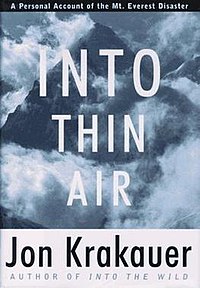
Into Thin Air, Krakauer


Into Thin Air
Jon Krakauer
1997
USA

“As I gazed across the sky at this contrail, it occurred to me that the top of Everest was precisely the same height as the pressurized jet bearing me through the heavens. That I proposed to climb to the cruising altitude of an Airbus 300 jetliner struck me, at that moment, as preposterous, or worse.”

            Most of us spend our lives seeking comfort. I am no exception. So it was a little weird to read this book while worrying about what furniture would look best my new apartment, and how to arrange my things in the most aesthetically pleasing way. In a way it made life easier for me, because the people I was spending time with during my reading hours were freezing and sick and gasping for air up on an unforgiving mountain, and so my little apartment without air conditioning, in comparison, seemed downright luxurious.
            Into Thin Air is a non-fiction book about the tragedies that occurred during climbing season on Mt. Everest in 1996. You may have heard of it; it was a bestseller. The author, Jon Krakauer, is an amateur climber, but his primary role on the Everest expedition was supposed to be as a reporter (he had originally intended to remain at Base Camp, but the allure of the summit was too much for him and he ended up climbing to the top, too). Commissioned by Outside magazine, Krakauer was to write an article assessing what many “purist” climbers referred to as the “commercialization” of Everest. He does a good job of filling us uneducated readers in on the argument between people who believe that only those who are able to climb without the aid of a paid guide should do so, and others who see no problem with Everest being run as a kind of extreme amusement park (there is a secondary debate, too, about whether using supplemental oxygen to reach the summit is cheating or not). Krakauer wrote his article for Outside immediately after returning from Everest in 1996, but found that he could not put the experience to rest. Twelve people had died, and Krakauer and many of the other climbers were still struggling to understand why. The book is the result of its author’s need for clarification, insight, and meaning. It attempts to offer the same to its readers and, at its best moments, succeeds.
            I haven’t read many “adventure” books, so I won’t pretend to be an expert on the genre. However, the type of tone and content that I would have expected from such a book was completely missing from Into Thin Air. Instead of larger-than-life characters, Krakauer seeks to humanize every person he meets on the mountain that spring. The reader is left with an impression not of heroic, impossibly strong mountaineers to be admired, but instead of real, often weak, eminently human men and women, attempting to summit the world’s tallest peak for a host of reasons, some more admirable than others. There are depressingly few moments of romantic vistas and awe-inspiring natural scenery; the few there are are almost completely outweighed by descriptions of dirty, festering camps, aching muscles and heads, broken bodies left behind in the snow, and the cruel ice, wind, and snowdrifts of Mt. Everest. There’s no doubt that the results of the climb soured Krakauer’s view of the entire experience, but it was fascinating to read a book written by someone who admittedly loves (loved?) climbing told in such a dark, almost angry tone.
Other climbers who were there that spring have since denounced Krakauer, claiming that his version of events is not entirely true (mostly this has come from one of the guides who believes Krakauer painted an unfairly negative portrait of him). Clearly, I don’t know whether what Krakauer writes is 100% “true” or not, but I am convinced that he is reporting to the best of his and others’ knowledge. He seems desperate to find the truth at whatever cost to himself or others’ views of themselves, and I find that convincing evidence of his impartiality. Krakauer wants to know why, but not so badly that he twists the story to create a clear-cut, specific reason that explains it all. Instead, he tells what happened, moment by moment and day by day, and we must decide for ourselves along with him about what went wrong.
One of Krakauer’s central claims seems to be that the accidental deaths that occurred on his trek to Everest were not, contrary to popular belief, all that unusual. “If you can convince yourself that Rob Hall [the expedition’s leader] died because he made a string of stupid errors and that you are too clever to repeat those same errors, it makes it easier for you to attempt Everest in the face of some of the rather compelling evidence that doing so is injudicious. In fact, the murderous outcome of 1996 was in many ways simply business as usual. Although a record number of people died in the spring climbing season on Everest, the 12 fatalities amounted to only 3 percent of the 398 climbers who ascended higher than Base Camp – which is actually slightly below the historical fatality rate of 3.3 percent.” Perhaps it should seem obvious to us that climbing the world’s highest peak is a life-threatening task. But, this late in the game, I think many of us have the sense that if we pay enough for something (and the people on Rob Hall’s expedition paid upwards of $65,000 for their opportunity to reach Everest’s summit), and if we are important enough (there were many, many doctors and a minor celebrity upon the mountain that spring) then we simply won’t die from taking an extreme vacation. It seems like there are safety precautions in place for everything; planes can fly anywhere, and if something goes wrong, we will sue somebody. Into Thin Air reminds us that sometimes things go wrong anyway, and that sometimes there isn’t any one person or company at fault; sometimes you just have to live with death. It turns out there are still are places that are truly wild, and untamable. I guess that’s why people go out there to seek them, to find those places where all bets are off, where it isn’t necessarily going to be okay, where every tiny movement you make is the difference between life and death. I can understand that, I think. It’s something primordial, a desire to be back at the beginning, when it was just man and woman vs. wild, and all of these other, silly, side issues, like how many people are reading our blogs and whether or not we impressed our boss, didn’t even exist. When you’re focused on survival, you can finally let all your other cares go.   

            A quick Google search of “climbing Mt. Everest” reveals that despite the danger, people are still interested in reaching the summit. Call me crazy – and there’s no way I’m ever trying to go to the top – but this expedition to Everest Base Camp sounds pretty good: http://www.akextremeadventures.com/adventure-travel/expedition/mount/everest/base-camp/trek/packageID/5208?did=5199&jt=1&jp=&jadid=10539367819&js=1&jk=climb%20everest%20expedition&jsid=24506&jkId=gc:a8a8ae4e72f9eb09d012fa532374a69b3:t1_b_:k_climb%20everest%20expedition:pl_&&gclid=CLzGsMnF07ECFYeo4AodMkkA0Q. 30th birthday trip, perhaps? ;)